Human speed, not machine speed
Every automatic reply waits a randomised 30 to 90 seconds before it is sent. A person needs at least half a minute to read and answer, and machine speed is exactly what platforms detect.

✦Free forever — no credit card
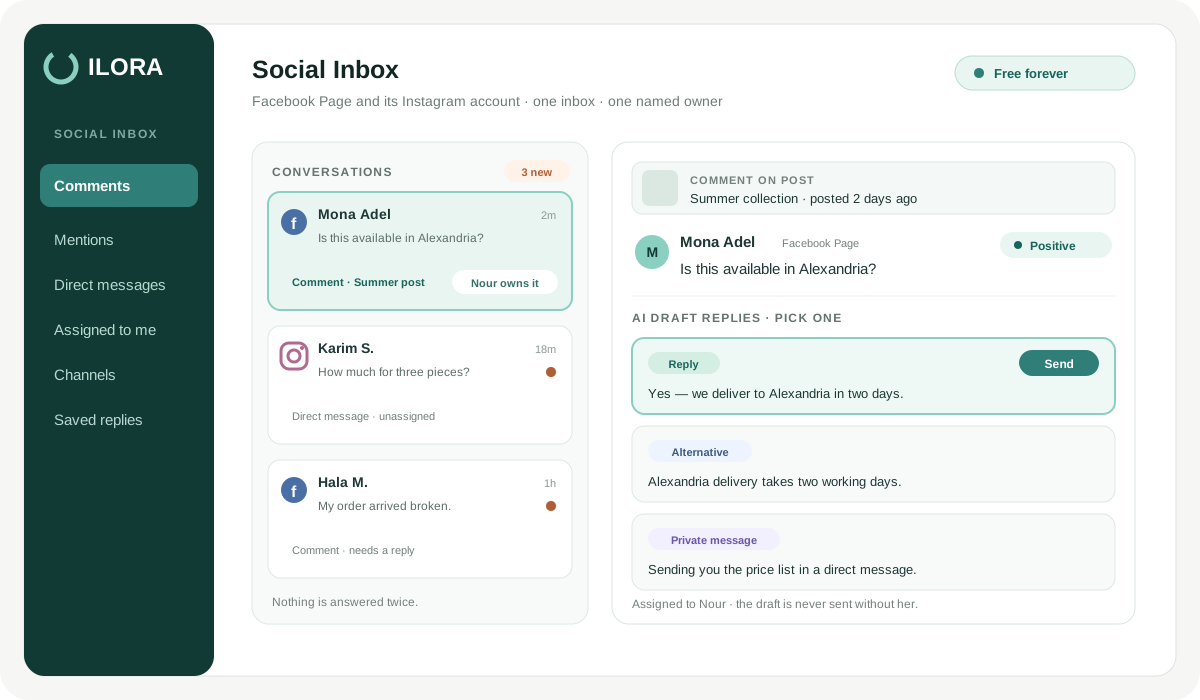
Connect your Facebook Page and its Instagram account, and every comment, mention, reply and Direct Message lands in one inbox — with the post it was written under, an AI draft ready to send, and one named owner so two people never answer the same person twice. Free for three people, forever.
Free forever — not a trial. No credit card.
01The problem
Nobody set out to ignore them. Comments simply do not behave like messages: they sit under a post, they arrive in the middle of a hundred emojis, and the notification is gone by the time anyone opens the app.
Someone asks the price in public, in front of everyone who scrolls past. Nobody answers for two days — so the whole audience reads that as your answer.
Facebook shows you one comment at a time. A reply attached to a sibling comment on the same post might as well not exist, so the same question gets answered three times and the angry one gets answered never.
The page password is on three phones. Two of your team answer the same customer, in two different tones, sometimes with two different prices.
A discount was offered in a comment last Tuesday. Which comment, by whom, to whom? The thread has moved on and there is no record.
Somebody mentions your brand somewhere you were not looking, and you hear about it from a friend a week later — when it is a screenshot instead of a comment.
02The comment inbox
Most inboxes treat a comment as a message with no context, because that is how the platform hands it over. We rebuild the thread instead: open any comment and you get the whole conversation under that post — the root comments, the replies beneath them, and your own answers nested exactly where they were sent.
Open one comment and you see every comment and reply on that post, nested by parent — including the answers your team already sent. No more replying to something that was handled an hour ago.
Some comments do not deserve an answer. Hide it from the thread without leaving the inbox, and get on with the ones that are actually customers.
Each comment comes in with its intent and its tags already on it, so a queue of 80 comments sorts itself into questions, complaints and noise before you read a word.
03Auto-reply, on your terms
The fastest way to embarrass a brand is a bot answering forty comments in half a second, in public, at three in the morning. So automatic replying ships switched off, and when you do switch it on it runs inside limits written in the code rather than promised on a page. These are the actual numbers.
Every automatic reply waits a randomised 30 to 90 seconds before it is sent. A person needs at least half a minute to read and answer, and machine speed is exactly what platforms detect.
The instant one of your team replies in a thread, the AI stays out of that thread for four hours. The customer is talking to a person now, and two voices answering at once is the failure everyone sees.
A hard ceiling on automatic replies per channel per day. When it is reached the bot stops for the rest of the day rather than degrading quietly into nonsense.
One conversation can receive at most eight automatic replies in a rolling 24 hours. A customer who keeps writing reaches a human, not a loop.
No automatic replies overnight. A 3am reply is not service, it is a notification nobody asked for — and it is read in your organization's own timezone, not a server's.
A blocked reply is not retried, not queued, and not downgraded into a generic apology. Nothing is sent and the conversation stays with the humans — a rule in the code, not a slogan.
04Brand listening
Write rules on the words that matter — your brand name, a product, a competitor, a mention of your page, or comments on one specific post. Every match is stored with its sentiment and its topic, so “people are angry about delivery again” becomes something you can see instead of something you sense.
Keywords, mentions of your page, or comments under a chosen post. No query language, no setup project — type the word you care about and it starts matching.
Each match is classified as it lands and tagged with what it is actually about — pricing, support, a bug, speed — so the complaints separate themselves from the compliments.
Mark a rule as competitor tracking and the negative mentions it catches stop being trivia. See the next section for what happens to them.
05From comment to pipeline
Somebody says, in public, that a competitor let them down. That is not a mention to archive — it is the warmest lead you will get this week. So the free tier includes the CRM, and the path from the comment to a named owner is wired, not manual.
A competitor-tracking rule matches the mention, and the sentiment comes back negative. Both conditions, not just the keyword — a happy mention of a competitor is not an opportunity.
The match becomes a CRM lead automatically, carrying where it came from, so nobody has to notice it, copy it, and type it in before it goes cold.
The conversation links to that lead — or to an existing client if you already know them — with exactly one named owner. Everyone can see the history; one person is answering.
06What is included
Everything on this page, for three people, with no card and no expiry date.
The token budget covers the drafts and auto-replies. Voice and video transcription is not part of this tier.
You are inside the same system a full ERP runs on. Nothing is migrated when you open more of it — the conversations, leads and owners you built for free stay exactly where they are.
Run your customer service on WhatsApp too? That is its own free tier — a different module with its own inbox, not included in this one. And the full price list lives on the pricing page.
07FAQ